The Tattooist of Auschwitz Book Summary and Review
Here’s a brief summary of The Tattooist of Auschwitz about the real-life Holocaust survivor, Lale. This summary of the main points of the book are just for your understanding before your read the review.
The True Story of Lale Sokolov
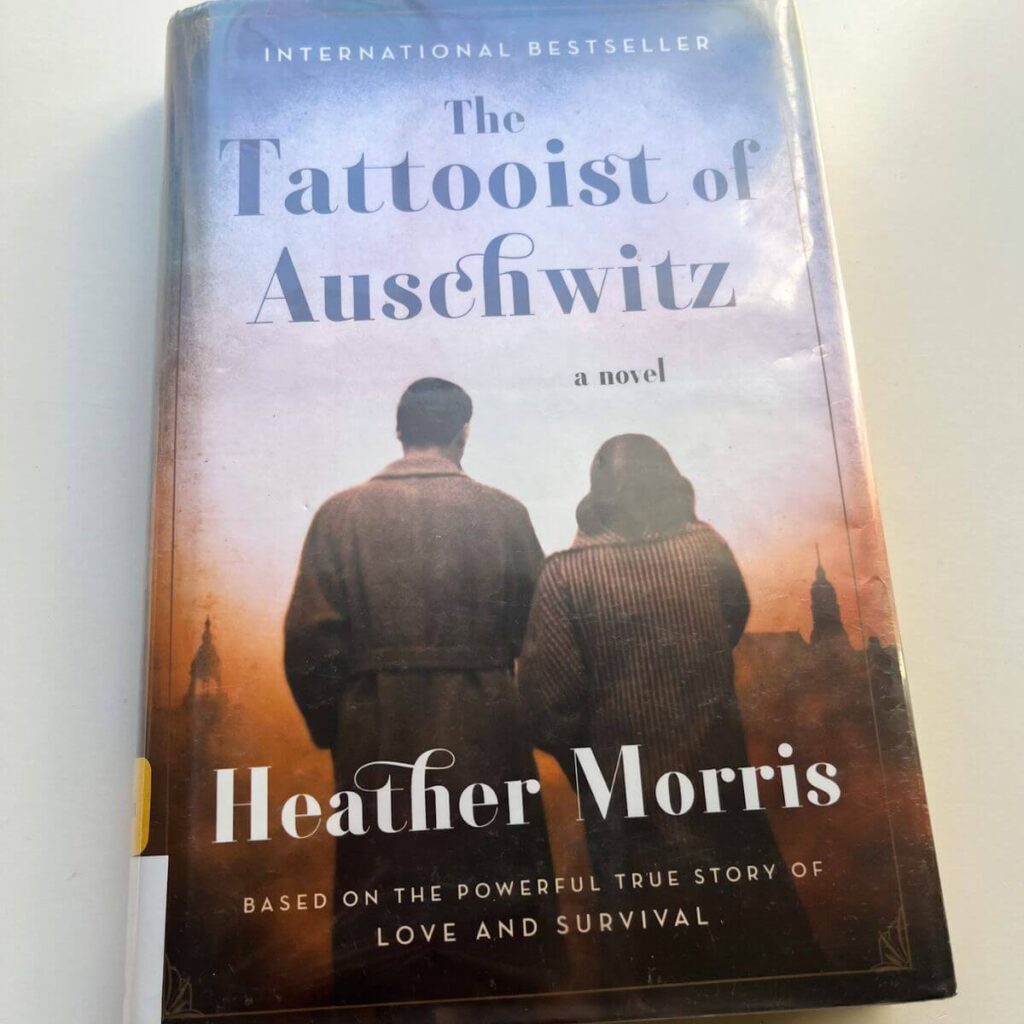
In this heart wrenching story of true love among despair, The Tattooist of Auschwitz is the amazing retelling of Lale’s story with his fellow prisoners and Holocaust survivors. I have a full book review of it here. For your general knowledge and to help remember the main points of the book to better understand the review, I’ve briefly summarized some of the main points below.
Note: At the end of the book, the author points out that there may be some historical inaccuracies as Lale told her the story over years of interviews at the end of his own life. It’s still a beautiful love story and a story about the triumph of the human spirit.
Chapter 1 April 1942
Lale is packed into a cattle car with fellow Jews from Czechoslovakia headed for Poland. Lale tries to stay positive as the other men despair about their conditions in the wagon the last few days. The Germans demanded every Jewish Slovakian family provide a man over 18 to work for the Germans, so Lale volunteers to go in order that his parents and siblings who are married and have kids won’t.
After days of travel, they make it to Auschwitz-Birkenau concentration camp where Lale and the other men are shuffled in and given serial numbers which are tattooed on their arm. Lale looks down at his-32407.
In the night, Lale wakes up to go to the bathroom. Hesitantly, he hears voices and sees three fellow inmates using the bathroom as guards approach. The SS officers nonchalantly shoot the three prisoners and push their bodies into the ditch behind them.
Chapter 2
The next morning, guards instruct them to work and listen to their kapo-the German word for a prisoner who’s their leader. Then, they’re taken to build more bunk houses, and Lale is told to work on the roof. In the roof, he meets two Russian soldiers, Andor and Boris, who fill him in on limited details they know.
At this camp, the prisoners are designated by symbols on their shirts. They tell him that green triangles are dangerous criminals, red triangles are anti-German political views, yellow star is Jewish, and black triangle seem lazy as far as they can tell. The Russians don’t wear anything because they’re just the enemy.
As the days pass, Lale works hard, barely talks, and follows orders because he’s determined to make it out alive. It’s a little easier for Lale because he can speak so many languages including German, Russian, Polish, and French. His kapo notices and tells him to be his errand boy. Later, Pepan offers Lale a job as a tattooist with him as long as he doesn’t make any trouble. This is a privileged position that allows him to move around the camp freely.
Chapter 3 July 1942
As female prisoners are brought in, Lale hesitantly tattoos a young woman who he stops from talking back to the guards. They smile at each other, and later you find out this is Gita who Lale says was his love at first sight.
Then, when he shows up to work a few weeks later Pepan is gone. A guard, Baretski, is set to watch over Lale as the new head tattooist. Lale also gets an assistant named Leon.
As head tattooist, Lale gets his own room in a new bunkhouse building with a private room and special perks – more rations for food and more freedom in camp. He’s now part of the political wing of the camp and under their protection. One day, he sees the woman who smiled at him and has to be pulled away from looking at her by his guard to get to work.
Chapter 4
Baretski brings him supplies to write to the girl who smiled at him. He just introduces himself and asks her to meet him. She replies that she will, but leaves out her name.
Lale also struggles with Baretski, who has a temper and talks disrespectfully about women. Lale’s just glad if he can avoid a beating from the guard who likes to rough up prisoners.
Chapter 5
On Sunday, when there’s no work for prisoners, Lale meets the girl for their first encounter they can talk to each other and finds out her name is Gita (she won’t say her last name). The next Sunday, they talk a little more and find it easy to joke together. But all their meetings must be kept very short because of the guards around.
Chapter 6
One day, he talks to the bricklayers who don’t wear uniforms and finds out they’re local workers paid to build here. Victor, the worker, tells Lale they’re building a crematory. Then, Victor gives Lale some sausage with the promise of more food in order to help.
Lale wants to bring the sausage to Gita and find a way to repay Victor. He stops two women who work in the building with Gita sorting through the discarded possessions of arriving prisoners. Offering the sausage, Lale asks if the women can smuggle him jewels or valuables from the discarded possessions.
Chapter 7
That winter, Gita gets sick with Typhus, and Lale is determined to help her. He trades Victor some money and jewels for penicillin which saves Gita.
Then, Lale asks Baretski for the favor of transferring Gita to a job in the administration building which has heating. Gita does get moved and is now working inside transferring prisoner information into ledgers. While working, she meets another nice prisoner, Cilka, who is remarkable because she’s the only prisoner without a shaved head.
Chapter 8
So many new prisoners are arriving at the camps that Lale works every day and into most nights. He meets a very large, muscular American named Jakub, who he helps at first. The next Sunday on his way to see Gita, he finds a crowd of prisoners and guards around Jakub watching him throw large beams and bend pieces of metal.
Lale brings Gita chocolate, and she kisses him. Then, Baretski pulls him from his conversation with Gita because there’s more prisoners arriving. Lale can tell something is wrong with Baretski today, and on the walk, Baretski shoots three prisoners who are just sitting on the ground.

Chapter 9 March 1943
Lale and Leon are told to tattoo a new group of prisoners with a Z in front of their numbers. Baretski tells them they’re gypsies, and, as they arrive, Lale sees children coming into camp for the first time. Luckily, Lale and Leon do not have to tattoo any children or babies.
At the administrative building, Cilka is suddenly pulled from her work with Gita. She’s taken to be a personal servant for Schwarzhuber, the head of Birkenau, who uses her for sex.
When Lale arrives back at his once empty bunkhouse, he finds that the gypsies have been placed here. It’s hard to get used to the noise of children at first, but he likes helping and hearing of their culture.
Chapter 10
Lale helps the gypsies settle in even though they’re all anxious for their fate. He encourages them to set up a sort of school system for the children. And he befriends a gypsy named Nadya who reminds him of his own mother which makes him both happy and extremely homesick.
Chapter 11 May 1943
Lale and Leon are still very busy with so many new prisoners coming in from all over Europe. By now, they’re used to the selection process of doctors taking some to Auschwitz concentration camp, the extermination camp, and others going to work at Auschwitz II-Birkenau.
Today, a new doctor appears for selection. Baretski tells Lale it’s Dr. Mengele, who even the soldiers are afraid of. Another day tattooing in Auschwitz, Lale stares at Dr. Mengele too long, and the doctor has guards remove Leon.
Chapter 12
Baretski asks Lale to form a soccer team of prisoners to play against the SS guards in a “fun” game. The men from his old bunkhouse, who he still brings food to, get a team together with him. At the game, the head of both Auschwitz and Birkenau show up to watch.
In the first half, the prisoners are better with many men who’ve played semiprofessionally before. But Lale impresses on them that they have to let the guards win in the end. In the second half, the prisoners are too tired from their poor diets to stop the prisoners anyways, so the guards end up winning.
Chapter 13
Lale is brought to Auschwitz where he sees a large group of naked women within a fence acting like zombies. Inside the adjacent building, Dr. Mengele is again inspecting women and choosing only some, who Lale is to tattoo. On his way out that night, the all the women are gone from the fence, and Lale throws up.
In a group of new arrivals, Gita runs into her old neighbor who’s much older and may not survive the work here. The neighbor tells Gita that the Germans also took her sisters and parents. She also says that Gita’s brothers had died months ago after joining the resistance.
There are now five crematories that run at Auschwitz while Lale tattoos more prisoners that Dr. Mengele specially chooses. After working long days there for weeks, Lale finally gets to see Gita again. They kiss, and Lale tells Gita she’s the love of his life even though she has little hope they’ll ever get out of this camp.
Chapter 14
It’s been several weeks, but Baretski returns a very malnourished Leon to where Lale is working. Leon tells Lale that Dr. Mengele starved him and removed his testicles. Lale is appalled and tells Leon to go to his room for the extra food.
One day, Baretski brings Lale to one of the gas chambers at Auschwitz because two prisoners have the same identification numbers. Upon entering the horrific scene just after hundreds of prisoners were killed, Lale inspects the two dead men’s tattoos. Barely holding it together, Lale tells the guards that one man’s 8 has just faded to look like a 3.
Chapter 15
After his heart breaking experience at Auschwitz, Lale must see Gita. During the day, Lale bribes the leader of Gita’s bunkhouse with chocolate to let him in and go get Gita from work. When she first arrives, Gita is terrified and then furious because she thought they were taking her away to die.
After she yells at Lale for scaring her, she runs into his arms. They have sex for the first time in the empty bunkhouse before returning to work.
Chapter 16 March 1944
Two boys come to Lale’s room asking help for their friend who was caught and brought back after escaping. Lale asks a woman he knows in the administrative building if they can get one more boy onto the transport to a different camp. The woman agrees, and the boy goes after he tells Lale his name is Mendel Bauer.
Chapter 17
Gita finally tells Lale what’s been happening to Cilka. He’s furious, but he says that he thinks she’s a hero along with Gita and, at the end of the day, all the ladies that do what they can to survive.
Chapter 18
Baretski says he knows Lale has a way of getting things from the outside and asks if he can get a pair of Nylon stockings for his girlfriend. Lake finds Yuri, Victors son, and they make the deal in exchange for two diamonds.
On a clear spring day, American planes fly over the camp exciting the prisoners who try to get their attention. When they fly off, the guard towers open fire on the prisoners out waving at the planes. Lale helps the gypsies gather those who have died, and, suddenly, it hits him that he’s somehow survived two years here.
Chapter 19
Lale returns to his room to find two guards waiting with all the stolen goods. They bring him to the head of camp who asks for the names of the prisoners who gave him everything. When Lale refuses, he’s taken to a punishment block in Auschwitz and starved for a few days.
Then, Jakub comes in with food for him and tells Lale that the Germans have hired him to beat information out of prisoners. Jakub tells him that he’s going to have beat Lale in front of the guards but he must not tell the names or those prisoners will die. Jakub does beat Lale who pretends to pass out, but when the guards leave, Jakub helps Lale heal.
After a few more days in the punishment block, the guards let Lale out.
Chapter 20
The head of camp sends Lale to Block 31, a punishment block where the prisoners have to work long days in the fields. The prisoners have to carry large rocks across a field, and the last one back is shot by the guards. Lale needs some help the first day, but the inmates tell him he’s on his own tomorrow.
Lale runs into Baretski and asks him to tell Gita and Cilka where he is. Gita is relieved, and Cilka realizes that Lale wants her to ask Schwarzhuber to get Lale out of there. Schwarzhuber agrees to Cilka’s request, and Lale is brought back to his old room.
Chapter 21
The next day, Baretski tells him he’s being watched closely and brings him back to tattooing because Leon is too slow by himself. After his work, he finds Gita who’s overjoyed to see him, and he decides to scale back but not stop smuggling food. The first thing he gets is a little chocolate to bribe Gita’s kapo into letting them into the empty bunkhouse together.
Chapter 22
In the middle of the night, the guards round up all the gypsies living around Lale. The next day during the tattooing of new prisoners, ash falls around them from the crematories working so much, and Lale realizes where they took all the gypsies. He’s so angry that he screams, and Dr. Mengele threatens to shoot him if he doesn’t get back to work.
Chapter 23
One autumn day when Gita and Lale are outside, they see crematory 4 blow up. There’s gunshots around them and screaming. Lale hides Gita against a building until it’s safe to go back to their bunkhouses.
That night, Lale talks to the new Hungarians who’s been put into his bunkhouse. Women who work in the nearby ammunition factory had been smuggling gunpowder into men planning a rebellion. The Hungarians also tell Lale that before they were captured, they heard the Russians were advancing this way.
Chapter 24
In the winter of 1945, transports of new prisoners have slowed to a stop. One day in late January, Gita finds Lale to tell him that the guards are all acting very strange and getting rid of the records in the administrative building. Lale instructs Gita and all her friends to stay inside their bunkhouse.
Then, he goes to the administrative building and finds out that they’re planning on evacuating tomorrow because the Russians are nearby. Lale isn’t sure what they’re planning on doing with prisoners, so he tells all the women and his bunkhouse to stay indoors. That night, Gita and her friends are marked with a red slash on their backs.
In the middle of the night, Lale wakes up to guards herding hundred of women prisoners out of the camp. He runs to try and find Gita, but guards stop him. She calls out to him that her full name is Gita Furman, which she’s never told him, as the gates are shut behind the women, and he thinks that’s the last time he’ll ever see her.
The next morning, Lale wakes to chaos. He makes his way to the train taking away prisoners and guards as he sees remaining prisoners in camp being shot at random.
Chapter 25
The women are marched for a few days through the snow to a train waiting to take them somewhere else. While the guards are distracted, Gita and four polish girls run to a nearby farmhouse. The family there remove the red marks from their jackets and send them to family members in a nearby village.
The girls are hidden in the village at first until Russian soldiers liberate the area. The girls eventually make their way to another town in Poland where Gita meets someone from Slovakia who will take her back. Gita makes it back to her home town and eventually runs into her two brothers who have been fighting for the Russians.
Chapter 26
Lale’s train takes him to Maurgausen in Austria where he stays a few weeks doing virtually nothing. He befriends a guard who gets him sent to a “slightly better” camp in Vienna, but here he decided they won’t take any more of his time from him. Lale escapes through a back fence and runs off into the woods where he hears gunfire somewhere nearby.
Chapter 27
The next morning, he wakes in the woods and walks until he finds a road with Russian soldiers who ignore him. Finally, as he’s walking, Russians soldiers in a jeep pick him up and bring him to their headquarters in the area because he can speak Russian and German. He’s given a nice room with a private bathroom and clothes, but told he’ll be shot if he tries to run away.
The Russians put him to work getting young women in the nearby village to come party with the Russian soldiers in exchange for money and jewels. The women in the village are used to it and say they need the money. Lale notices that all the women come in a good mood and leave each night without distress.
After weeks of doing this, his personal guard tells Lale that he’s being transferred, and Lale will be going to get the women by himself tomorrow. The next morning, Lale dresses, grabs the extra jewels he’s been hoarding, drives into town alone, and grabs a bicycle left on the street. He makes his way to a train station, partially on foot after some Russian soldiers take his bike, and the train takes him back to Slovakia.
Chapter 28
Lale makes it back home to find only his sister living there with her new Russian husband. His parents, sister-in-law, and nephews were all taken away while his brother died fighting for the Russians. After telling his story, his sister insists he goes to find Gita in Bratislava, the Slovak city where most returning from camps were being dropped off by train.
Lale goes to the train station here for weeks without any leads until the stationmaster tells him to try the Red Cross office. On his way, Gita sees him as she’s walking down the street and comes to him. Lale is not able to move at first, but, then, he asks Gita to marry him.
Epilogue
Lale and Gita do get married, and Lale opens a very successful textile importing business in Bratislava. Eventually, after the Russians take over, Lale is arrested for anti-Soviet activity and sentenced to two years in prison. Through some bribes and their network of friends, Lale escapes from prison by acting mentally unstable, and him and Gita make it to Paris.
Eventually, there’s no work for non-French citizens, so the two make their way to Melbourne, Australia. Lale opens a textile importing company there, and Gita designs dresses for the company. After many years of trying, they have a son named Gary.
Read the Full Book Review
Now that you’re reminded of all the major points in the book, you can read the full book review here.